NEO PI: industrial data historian for regulated environments
Turn scattered readings from sensors, machines and equipment into the reliable memory of your plant: a single, contextualized and auditable source for operations, quality and electronic batch records.
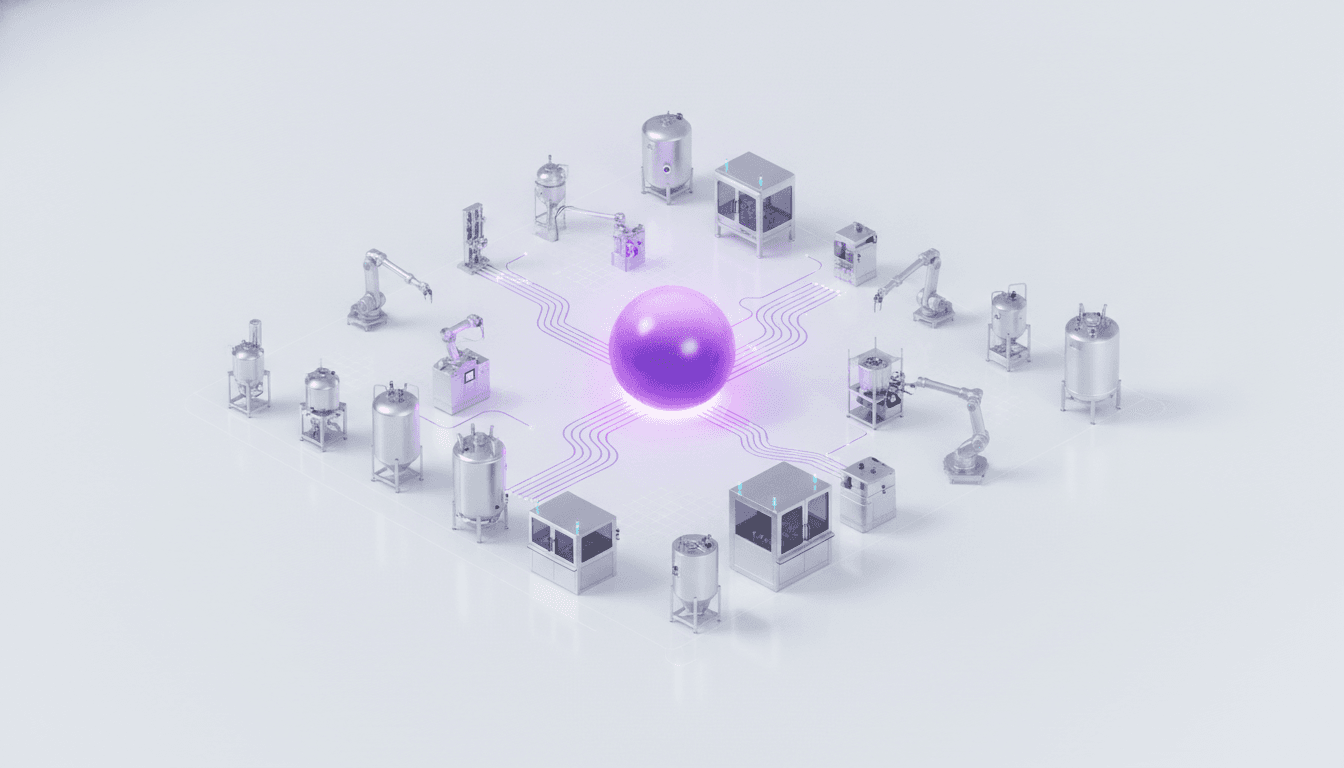
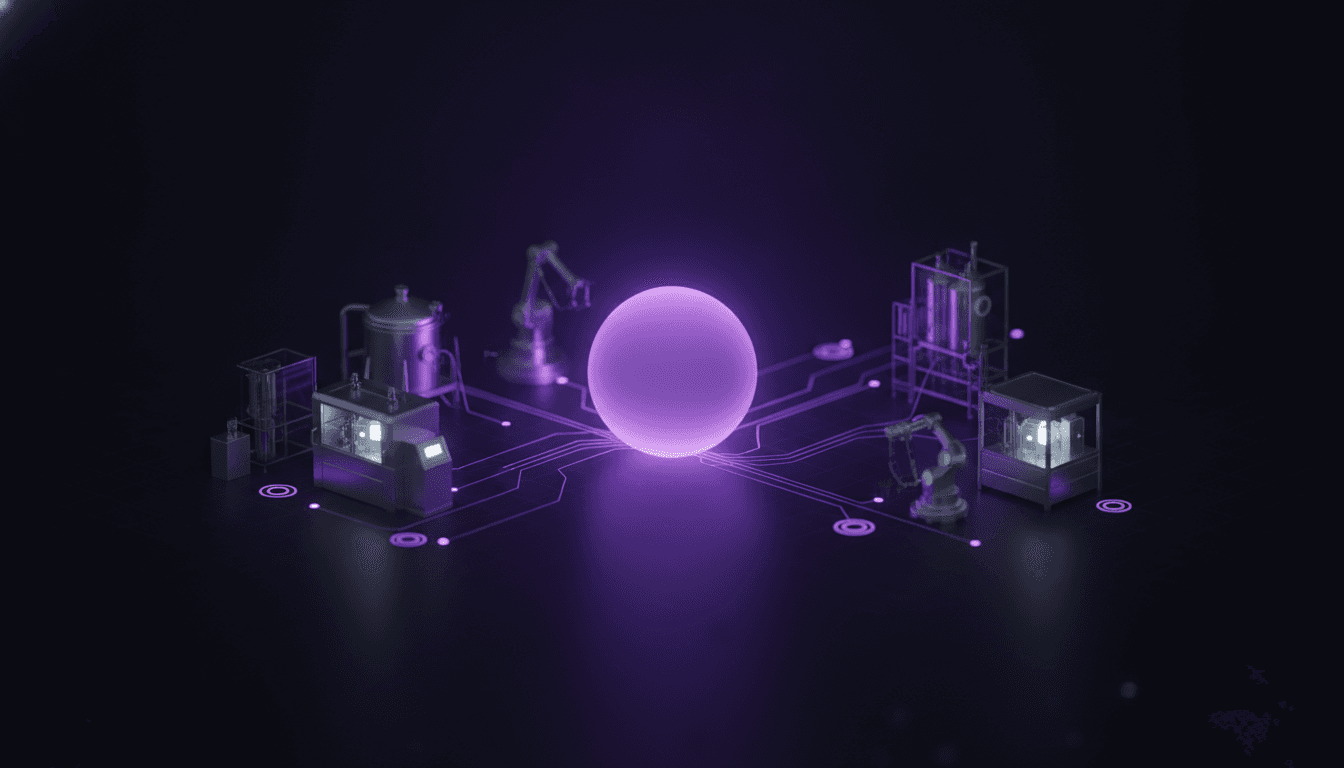
NEO PI is not a sensor database. It is your plant’s memory: what happened, when, at what measurement quality, and under which process asset.
The name is no accident. NEO PI plays the same role a classic process information system plays in a plant — with one difference: it was born to operate inside a regulated ecosystem, integrated with the electronic batch record.
What is an industrial data historian?
An industrial data historian is software that continuously records time-stamped measurements from the plant floor — sensors, machines, PLCs and SCADA systems — and stores them, with their quality and their asset context, for later query and analysis. It is also called a process historian, a manufacturing historian or, in its classic form, a process information system.
Underneath, a historian is a time series database specialised for industrial signals: high ingestion rates, out-of-order and delayed readings, per-point quality codes, and aggregation over long retention windows. What separates a historian from a generic database is the context layer above it — the measurement is not a lone number but a reading of a named asset, in a named area, of a named plant.
NEO PI is that historian for regulated manufacturing. It ingests over OPC-UA, OPC-DA, MQTT, LoRaWAN and REST, organises everything under an ISA-95 asset hierarchy, and exposes it as a Unified Namespace for industrial IoT that MES, quality and analytics systems read from — the data foundation Industry 4.0 and smart manufacturing programmes depend on.
What NEO PI solves
Why regulated manufacturers need a modern historian
In pharmaceutical and other GMP manufacturing, a process value is not just an operational figure — it is evidence. Regulators expect records that satisfy ALCOA+ (attributable, legible, contemporaneous, original, accurate, and complete, consistent, enduring, available), and frameworks such as FDA 21 CFR Part 11 and EU GMP Annex 11 set expectations for electronic records, audit trails and electronic signatures.
A spreadsheet exported from a datalogger fails most of those tests at once: it is not contemporaneous, its origin is not attributable, and nothing prevents a silent edit. A modern historian closes that gap by capturing the reading at the source, keeping the original event write-once, and recording every configuration change in a hash-chained audit trail.
That is what makes a historian part of a digital compliance strategy rather than a purely technical purchase — and why it belongs inside the scope of your computerised system validation under GAMP 5.
See it running
A walkthrough of the console: live dashboard, asset navigation, trends and audit trail.
A demo on your protocols and your assets says more than any screenshot.
Connections
When the format is proprietary: codecs
Not every manufacturer follows a standard. A codec is a declarative expression that translates a vendor’s raw payload into measurements — configured through the interface, tested before saving, with an AI-assisted draft from a sample payload. In practice: equipment sending {"temp_raw":247} starts recording 24.7 °C without a line of code and without waiting for a release, so connecting a new device is a configuration task rather than a project.
Data goes out too: data forwarding
Data forwarding rules deliver readings to external systems by webhook (HMAC-signed, token-authenticated) or MQTT publication, with optional payload transformation, batched delivery, a durable retry queue and automatic shutoff when a destination keeps failing. The durable queue is what keeps a downstream outage from turning into a gap in your records.
Connecting the installed base is a project in itself — our industrial IoT solution covers the wider picture, and connecting the shop floor over OPC-UA and MQTT walks through what that looks like in practice.
Integration with PLCs, SCADA, MES and ERP
Upstream, NEO PI speaks to the control layer directly: OPC-UA and OPC-DA for PLCs and SCADA systems, MQTT for edge gateways and industrial IoT brokers, LoRaWAN for wireless sensors in areas with no network, and REST for anything able to POST. Proprietary payloads are handled by codecs rather than by custom development.
Downstream, it is a source rather than a destination. Manufacturing execution and the electronic batch record read current values and history over the read API; ERP, LIMS and BI tools consume the same REST and SSE endpoints; and data forwarding pushes readings out by webhook or MQTT where a system prefers to be fed. Scoped read keys mean each consumer sees only the assets it should.
Context, not an identifier
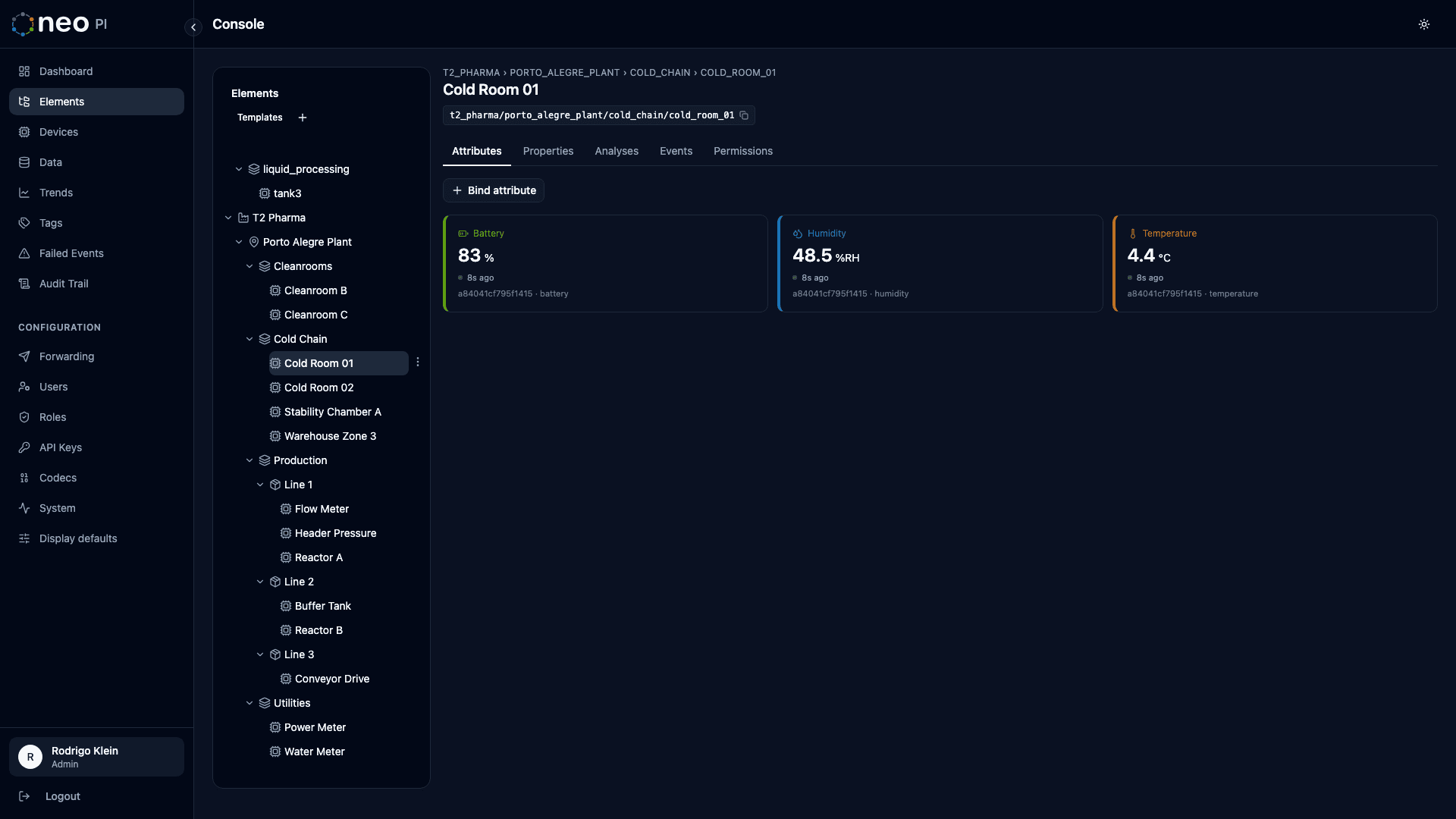
Navigate by plant › area › asset instead of by a raw device identifier. Every element carries its live measurements, its properties and its permissions.
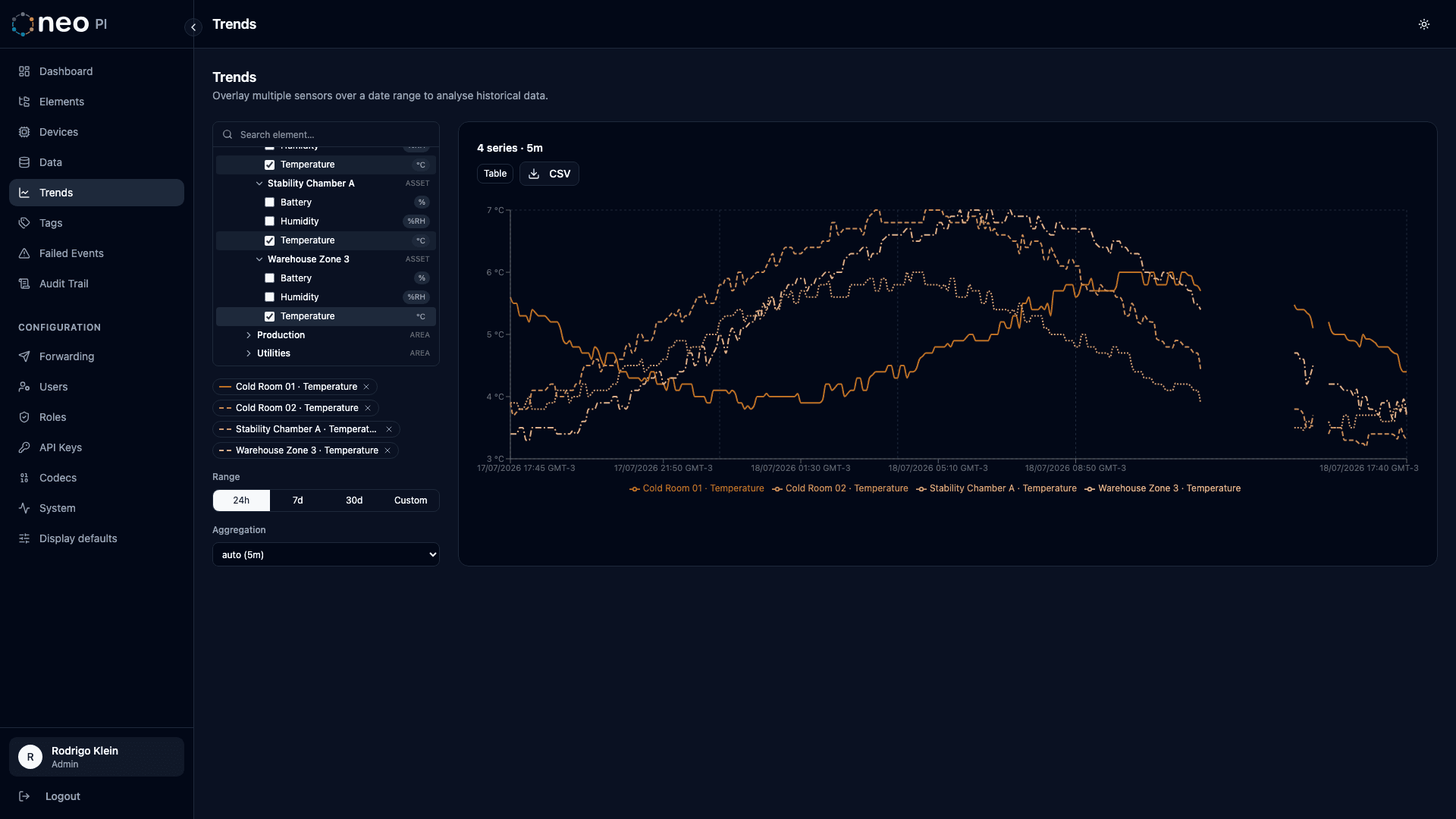
Overlaid trends
Several sensors on the same chart over any date range, with aggregations from raw to monthly and CSV export.
Typical applications
Integration with NEO EBR
The electronic batch record drives production: procedures, work orders, in-process controls. Historically, process values reach that record by manual transcription — an operator reads the display and types. That is simultaneously the slowest and the most fragile step of the record: subject to misreading, typing errors and delay, and it demands second-person review precisely because of that.
With NEO PI, the value comes from the historian:
- the in-process control in NEO EBR reads the measurement directly from the corresponding asset in PI
- the value arrives with its origin timestamp and quality, not the time someone typed it
- the batch record points to immutable data, traceable back to the raw event
- out-of-range deviations stand out against the full history, not an isolated point
EBR consumes PI through the read API, which exposes a navigable name space — a hierarchical path of the form plant/area/asset/measurement, the so-called namespace — with current-value reads, history queries with aggregations and live event subscription over SSE. All authenticated by scoped read keys that limit each consumer to exactly the assets and measurements it should see: the packaging team does not get the reactor data.
That API is an open protocol, and nothing about it is NEO-specific. NEO W&D, for weighing and dispensing reads weights from it the same way; NEO OEE, for equipment performance reads downtime; and any third-party system — MES, LIMS, ERP, a BI tool — consumes it over plain REST and SSE. PI is a layer your plant owns, not a captive component of one suite.
How the data flows
Data enters through any of the protocols, is preserved raw, gains asset context in the asset hierarchy (Asset Framework), and leaves by four paths.
- Machines and PLCsreactors · lines · filling — OPC-UA, OPC-DA
- Equipmentcold rooms · autoclaves · stability chambers — LoRaWAN
- IoT deviceswireless sensors · gateways — MQTT, HTTP, codecs
- Ingestionraw preserved, immutable
- Time seriestag catalog · aggregations
- Asset hierarchy (Asset Framework) / UNSsite › area › asset › measurement
- NEO EBRbatch record — Read API, scoped key
- NEO W&Dweighing and dispensing — same open API
- Operations and Qualitytrends · investigation
- Third-party systemsMES · LIMS · ERP · BI — REST, SSE, forwarding
How this differs from a traditional historian architecture
What each team gains
- Raw data kept write-onceThe original event is not edited or removed by the application, and retention follows your configured policy. Any number on screen traces back to what the device actually sent — which is what shortens an investigation.
- Hash-chained audit trailConfiguration changes are recorded in a chain with integrity verification — retroactive tampering is detectable.
- Electronic signature features designed to support 21 CFR Part 11 requirementsApplied to sensitive operations, with a signing PIN distinct from the login password and a meaning declared at the moment of signing. Qualifying the system for your regulatory context remains your validation activity.
- Real real-timeReadings appear as they arrive, with no page reload.
- Failure recoveryEvents that could not be decoded stay visible and can be reprocessed after the fix — nothing is lost silently.
- Role-based permissionsWith roles the organization customizes itself.
- No rip-and-replaceFive native protocols plus codecs for everything else.
- No lock-inData leaves by API, forwarding and live subscription — PI is a layer, not a final destination.
- Unified Namespace alignedISA-95 / IEC-62264: one shared naming structure for the whole plant (Unified Namespace), current state, event-driven ingestion and decoupled publication — so a new consumer plugs in without a point-to-point integration. Container deployment, multi-architecture.
- Less manual transcriptionIn the batch record — fewer errors, less rework, less review time.
- Shorter deviation investigationsHistory is contextualized and available, not scattered across dataloggers and spreadsheets.
- A base for what comes nextContinuous monitoring, trend analysis and process alarms finally have somewhere to read from.
Compliance and data integrity
Trustworthy readings are the foundation of data integrity and the ALCOA+ principles, and of the digital compliance posture an inspection actually tests. If you are still mapping the route from paper, the paper-to-paperless roadmap for pharmaceutical manufacturing sets out the usual sequence — and where a historian fits into it.
Frequently asked questions
What is an industrial data historian?+
It is software that continuously records time-stamped measurements from sensors, machines, PLCs and SCADA systems, and stores them with their quality and asset context for later query and analysis. It is also called a process historian or manufacturing historian.
How is a historian different from a time series database?+
A historian is built on time series storage but adds what industrial use requires: per-point quality codes, out-of-order and delayed readings, protocol connectivity, and above all an asset hierarchy that turns a raw value into a reading of a named asset in a named area of a named plant.
Which industrial protocols does NEO PI support?+
OPC-UA and OPC-DA for PLCs and SCADA, MQTT for industrial IoT brokers and edge gateways, LoRaWAN for long-range wireless sensors, and HTTP/REST for any system able to POST. Proprietary payload formats are handled by configurable codecs, without custom development.
What is a Unified Namespace and does NEO PI implement one?+
A Unified Namespace is a single, hierarchical naming structure for everything happening in a plant, so consumers subscribe to a shared model instead of building point-to-point integrations. NEO PI organises assets along ISA-95 / IEC-62264 lines and exposes that structure over its read API, with current state and live event subscription.
Does NEO PI support FDA 21 CFR Part 11 and EU GMP Annex 11?+
NEO PI provides features designed to support those requirements: electronic signature with a signing PIN distinct from the login password, a hash-chained audit trail with integrity verification, role-based permissions, and write-once storage of the original event. Compliance is a property of a validated system in its operational context, so qualifying the system for your regulatory context remains your validation activity.
Can NEO PI run on-premise, or is it cloud only?+
It ships as multi-architecture containers and can run on-premise, in a private cloud or at the edge of a single site. The deployment model follows your data-residency, network and qualification constraints.
Do I need the rest of the NEO platform to use NEO PI?+
No. The read API is an open protocol over REST and SSE. NEO EBR, NEO W&D and NEO OEE consume it, but so can any third-party MES, LIMS, ERP or BI tool. NEO PI is a data layer your plant owns, not a captive component of one suite.
If the answer involves spreadsheets, dataloggers or a system nobody queries, that is where a historian starts paying off. Let’s look at your installed base and what it would take to connect it. Talk to our team to assess protocols, equipment, GxP requirements and the integration landscape of your plant.