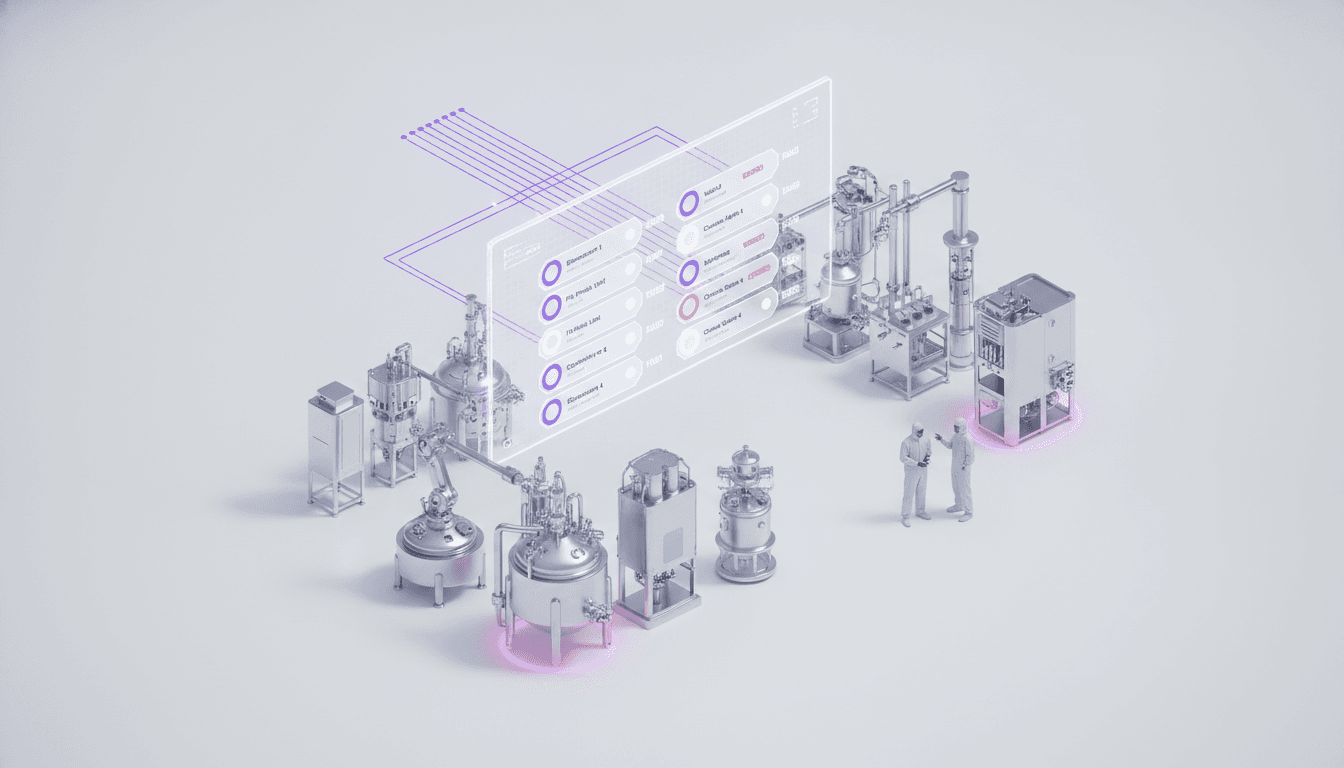
Finite capacity in APS needs cleaning and setup in the sequence


In regulated manufacturing, the production plan often breaks at the first product changeover. Not for lack of nominal capacity. Because sequencing treated cleaning and setup as slack between orders — when, on the floor, they are the work.
A common pattern: the APS (or the spreadsheet standing in for it) fits orders by process time. The plan closes. On the shift, the line needs cleaning between batches, format change, readiness checks. The delay shows up as “operational.” The next day, the plan stays optimistic.
What sequencing usually leaves out
Finite capacity without setup and cleaning is not finite capacity. It is nominal capacity with friction someone will discover on the floor.
Three recurring omissions:
- Cleaning time as a generic constant — when risk and procedure change with the product pair (A to B is not the same as B to A).
- Setup decoupled from the order — if the system does not know what must be ready before start, a “released” order arrives incomplete at the line.
- Shifts and maintenance as detail — a plan that crosses a shift handoff without inheriting real constraints becomes shift improvisation, not execution.
When that sits outside the model, the APS optimizes a scenario the line cannot run. The floor improvises; quality inherits deviation, waiting, and pressure to do it “just this once.”
Why this matters in GxP
In a regulated environment, cleaning and setup are not only logistics. They are controls. A cleaning procedure between products with cross-contamination risk is not a calendar gap — it is a step with acceptance criteria, evidence, and often line clearance before the next batch.
If the plan ignores that:
- shift pressure pushes shortcuts (skip verification, shorten waits, reorder “from memory”)
- the record drifts from what actually happened
- release time is spent reconciling the plan with reality
A sequencer that does not know cleaning is not planning production. It is pushing the gap onto the shift and, later, onto the batch record.
What changes when cleaning and setup enter the model
A useful design usually has three properties.
Explicit link to the product pair (or line state). Changeover time and procedure are not a “two-hour buffer.” They are typed activity: cleaning type X, format setup Y, with duration and preconditions.
Start blocked without readiness. The next order does not “start” in the system only because the clock arrived. If cleaning was not completed — and evidenced, where the process requires it — start stays blocked. It looks strict; in practice it avoids the failure mode where the plant moves and the record catches up later.
What-if the operation will actually run. Swapping two batches is only useful if the model recalculates cleaning and setups — not only slides bars on a Gantt. Otherwise nobody on the shift opens the scenario twice.
This is where APS stops being an isolated production-planning tool and starts talking to execution and resource readiness: plan and floor speak the same language. On the NEO platform, that integration sits in NEO APS, close to how resource readiness treats state and validity as start conditions.
The silent failure mode
The worst outcome is not that the plan slips. It is that the plan looks met.
Signals that sequencing is hiding the changeover:
- plan adherence rises while overtime and cleaning rework also rise
- orders “closed on time” with incomplete cleaning grids or signed after the fact
- daily manual replanning that always “fixes” the same product changeovers
- changeover deviations (line clearance, mix-up) concentrated on the changeovers the plan treated as trivial
In those cases, the plan number is stable because the definition of compliance loosened — not because the plant got more predictable.
Questions before promising plan adherence
Before selling or buying “finite capacity” as a benefit:
- Does the model distinguish cleaning and setup by context (previous product, next, line state), or use a single average time?
- Does the next order’s start depend on evidenced completion of the changeover, or only on the planned date?
- Do what-if and replanning recalculate cleaning, or only push bars?
- Is there a feedback loop to the floor (execution updates the plan), or is the APS a plan built in the morning that nobody updates after ten?
- Who owns the truth when plan and execution diverge — and is that written down?
If the answer is vague, the business case for plan adherence still has no basis.
Closing the loop
Useful sequencing in a regulated plant does not optimize process time alone. It carries the changeover — cleaning, setup, readiness — as a model constraint, not a side note. Real finite capacity begins when line changeover stops being the shift’s surprise.
In your plant last month, how many times was the “operational” delay actually a setup the plan never recognized?
Practical writing on GxP, MES, data integrity and shop-floor systems. A few times a month, no noise.