NEO LMS: industrial training and qualification, with a record that holds up
Most plants still run their training matrix on a spreadsheet. NEO LMS replaces it with records an auditor can follow — without assuming the person being trained sits at a desk. Three surfaces share one API: an administration console, a learner site with a public catalogue, and a mobile app built for a phone held in a glove.
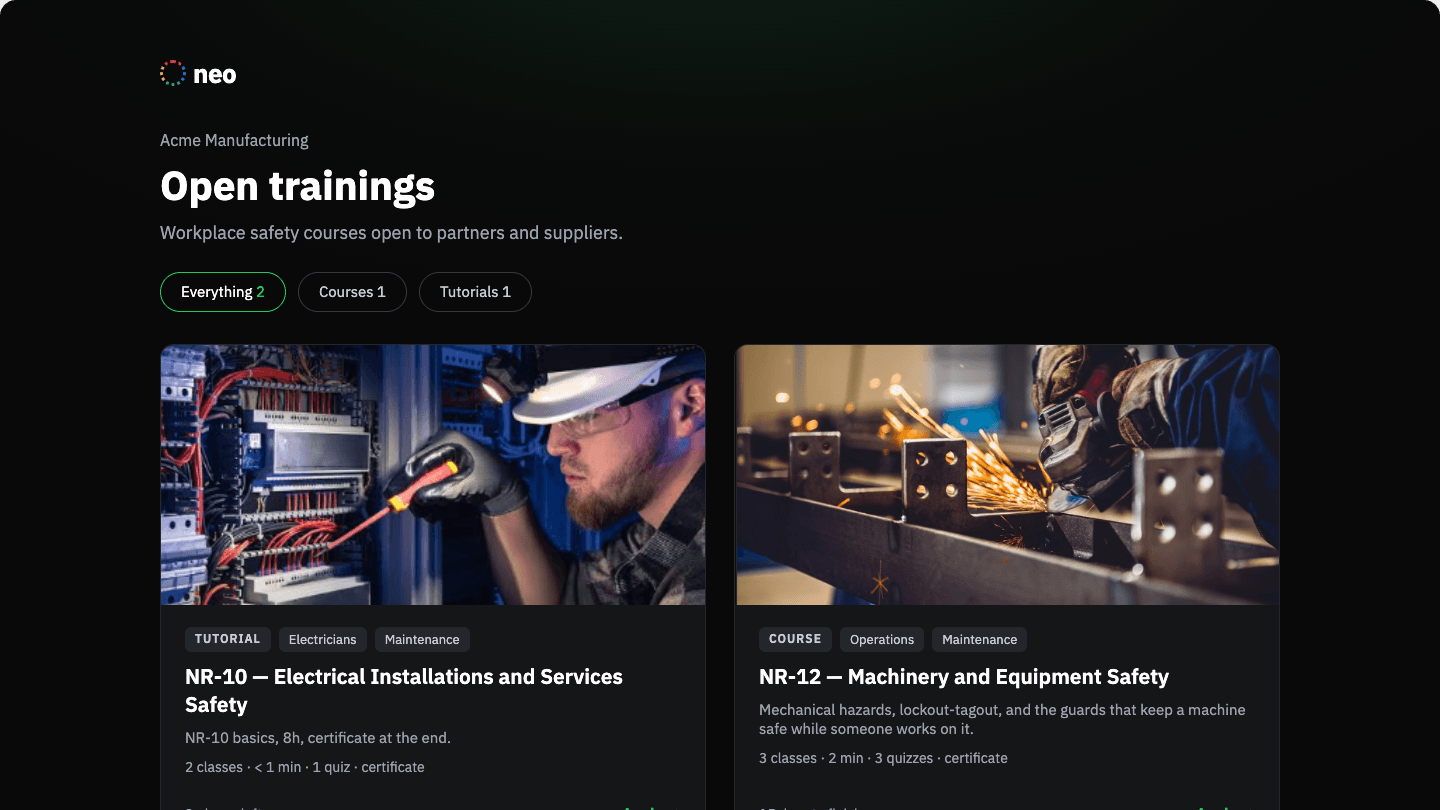
A training in NEO LMS is a tree: modules, each holding classes — a video, a reading or a document. A module may end in a quiz, and it is not finished until the quiz is passed, which is how a course that alternates video and assessment is expressed without inventing a second concept.
Publishing produces a version. Someone who started v1 finishes v1, and the version they took is part of their record — because a certificate that cannot say what was taught is not evidence of anything.
What NEO LMS does
From a course to a record that holds
The same four steps whether the training is watched at a desk, taken on a phone in the plant, or delivered by an instructor in a room.
- Modules and classesVideo, reading or document
- A quiz to close a moduleReusable, with its own passing score
- Publish a versionRefused while a video is still encoding
- To a personDirectly, one training
- Or through a planA set of trainings bound to a role or a group
- With a due dateOverdue first, then what is waiting
- On the learner siteOne class at a time, resuming where you stopped
- On the phoneSame tree, same completion rules, offline-tolerant
- Or in a sessionAttendance by QR code or by hand
- A completionAppended to the event log, never recalculated
- A certificateNaming the version taken and its validity
- A skill, and its expiryOn the matrix, and on the alert before it lapses
Training, authored and versioned
Every training carries its published version, the skill it grants and how long the resulting certificate stays valid. Publishing is refused while a referenced video is still encoding, and the refusal names the class at fault rather than failing quietly.
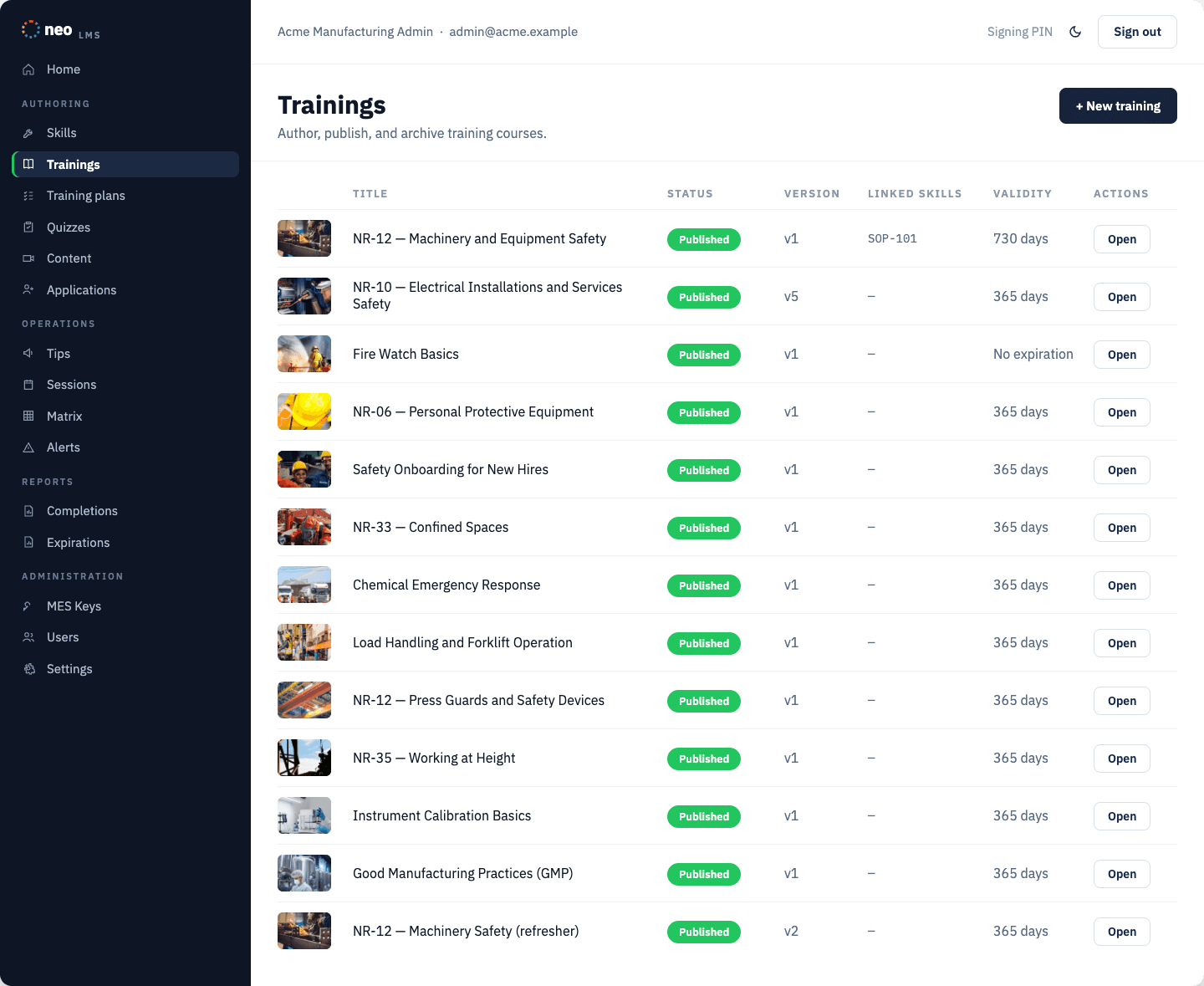
A module ends where the quiz is passed
Quizzes are authored once and attached to the modules that need them, each with its own passing score. A module is not finished until its quiz is passed — which is how a course alternating video and assessment is expressed without a second concept.
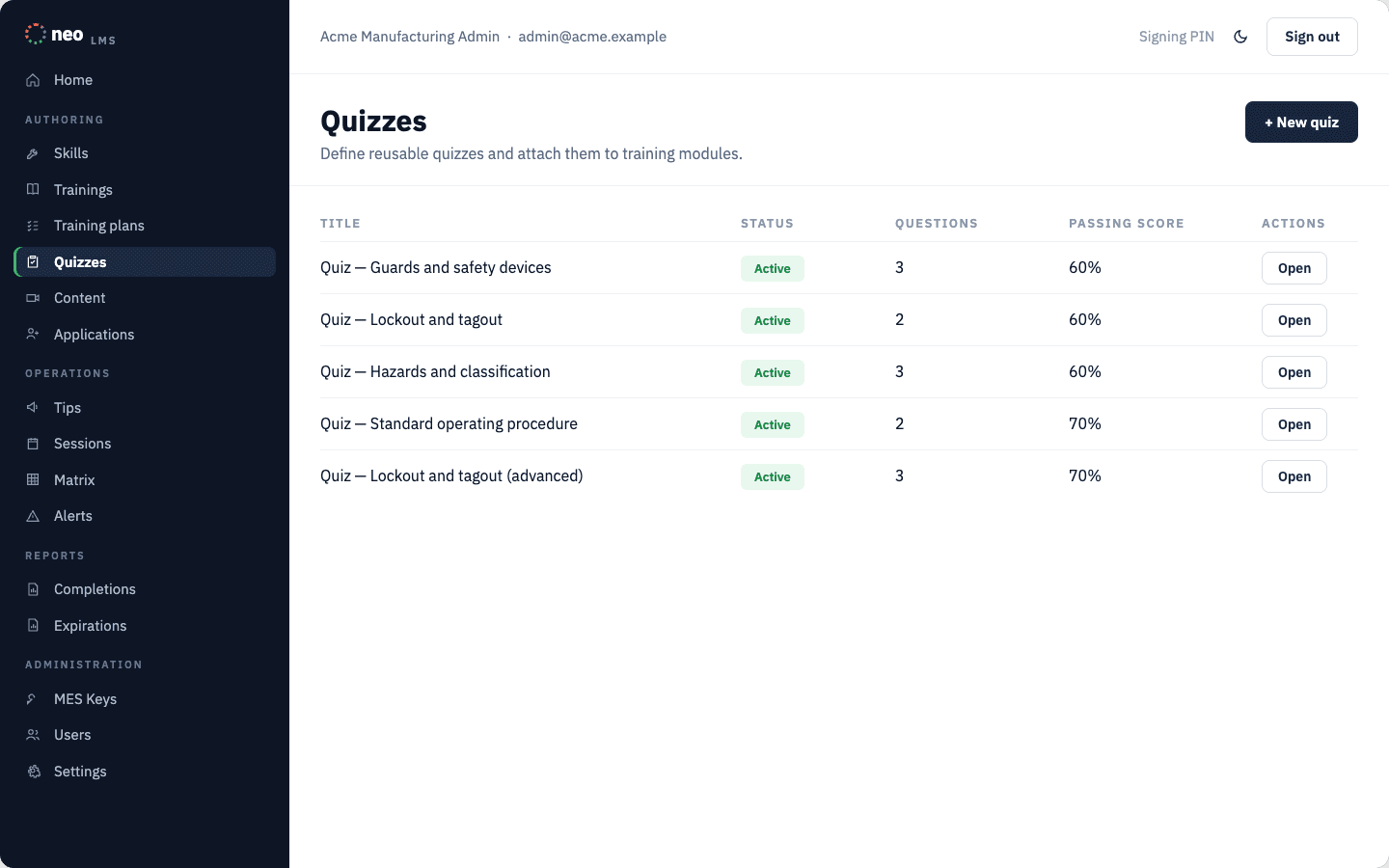
One library, one upload slot
Videos, documents and images live in one place and are referenced by the classes that need them. A video is uploaded once and encoded for delivery over a weak connection, with an offline copy kept; a PDF goes through the same slot and skips encoding.
Assignment, qualification and the room
Training is assigned to people directly, or through a training plan that binds a set of trainings to a role or a group — so onboarding is a plan, not a checklist somebody remembers to run. Every assignment carries a due date, and the console opens on the honest answer to are we compliant right now: overdue first, then what is waiting to start, then where the backlog sits by training.
Completing a training grants a skill, and skills expire. The qualification matrix shows a plant as a grid of people against skills, and alerts surface what is about to lapse before it lapses rather than after.
Not everything is self-paced. An instructor-led session has a date, a roster and an attendance list confirmed by QR code or by hand; closing the session issues completions for whoever attended, with an optional quiz after.
Enough to decide before applying
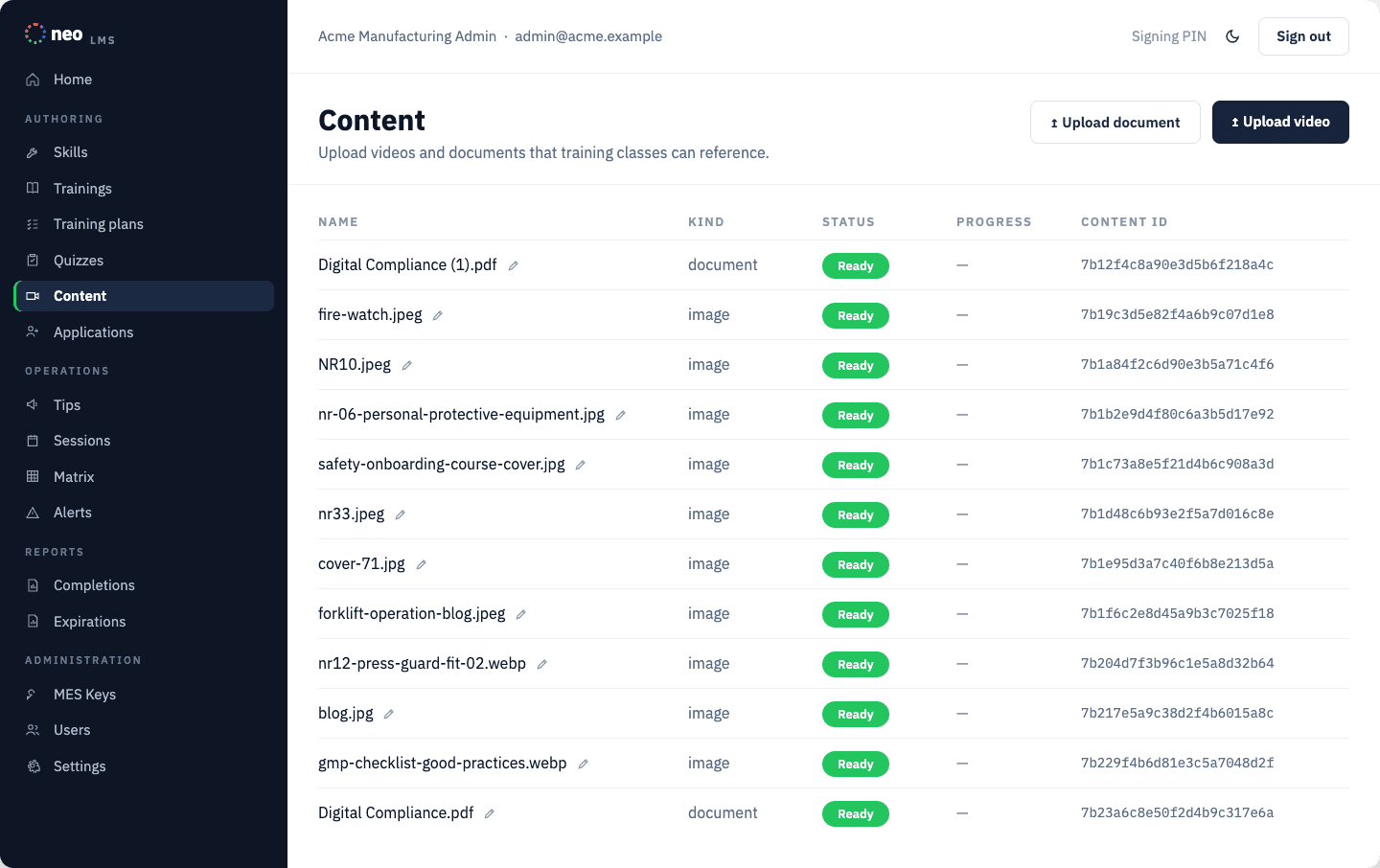
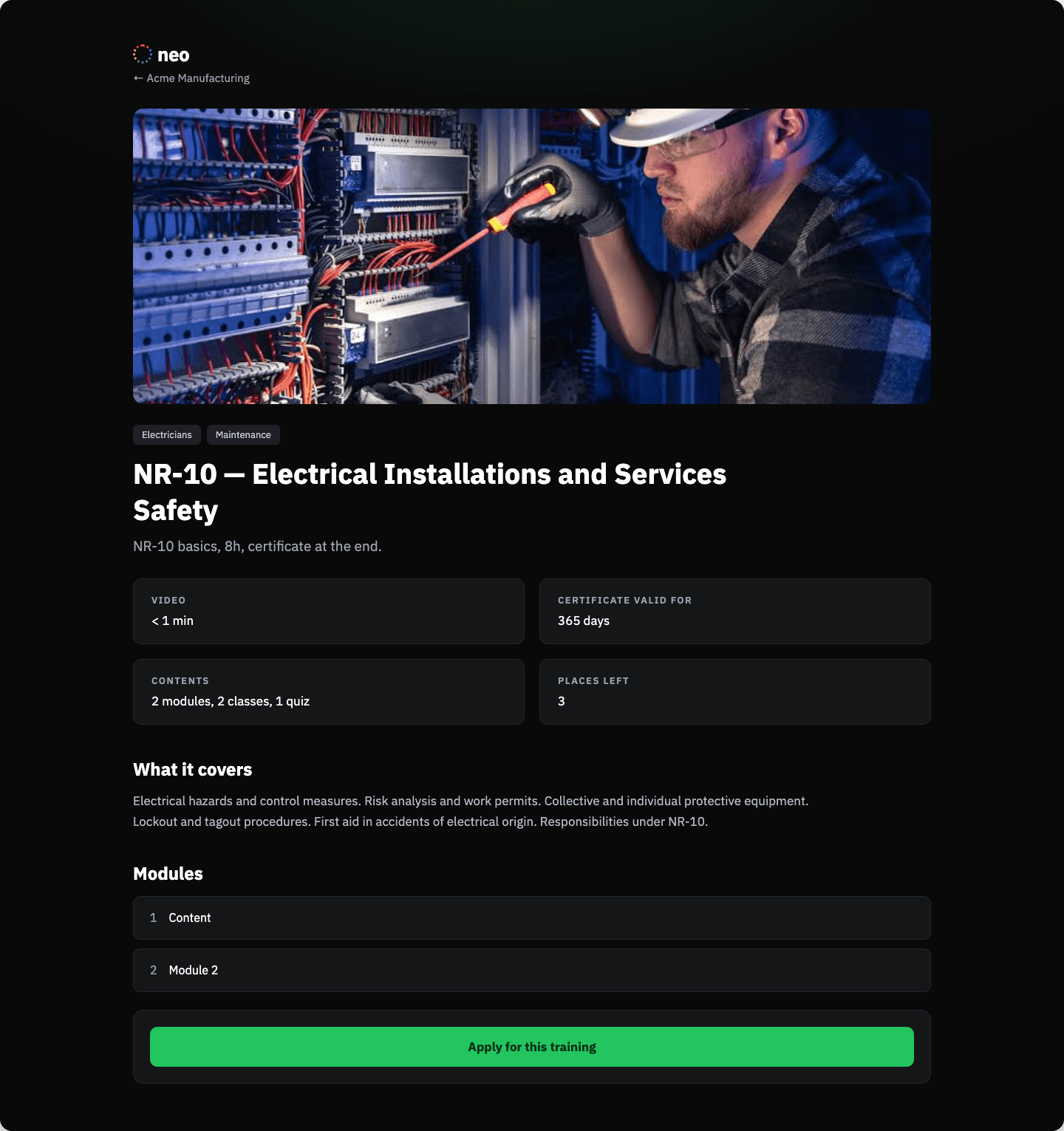
A published training gets a page anyone can read without an account: what it covers, how long it takes, how long the certificate is valid, and a free sample class. From there an outsider applies, and an administrator decides.
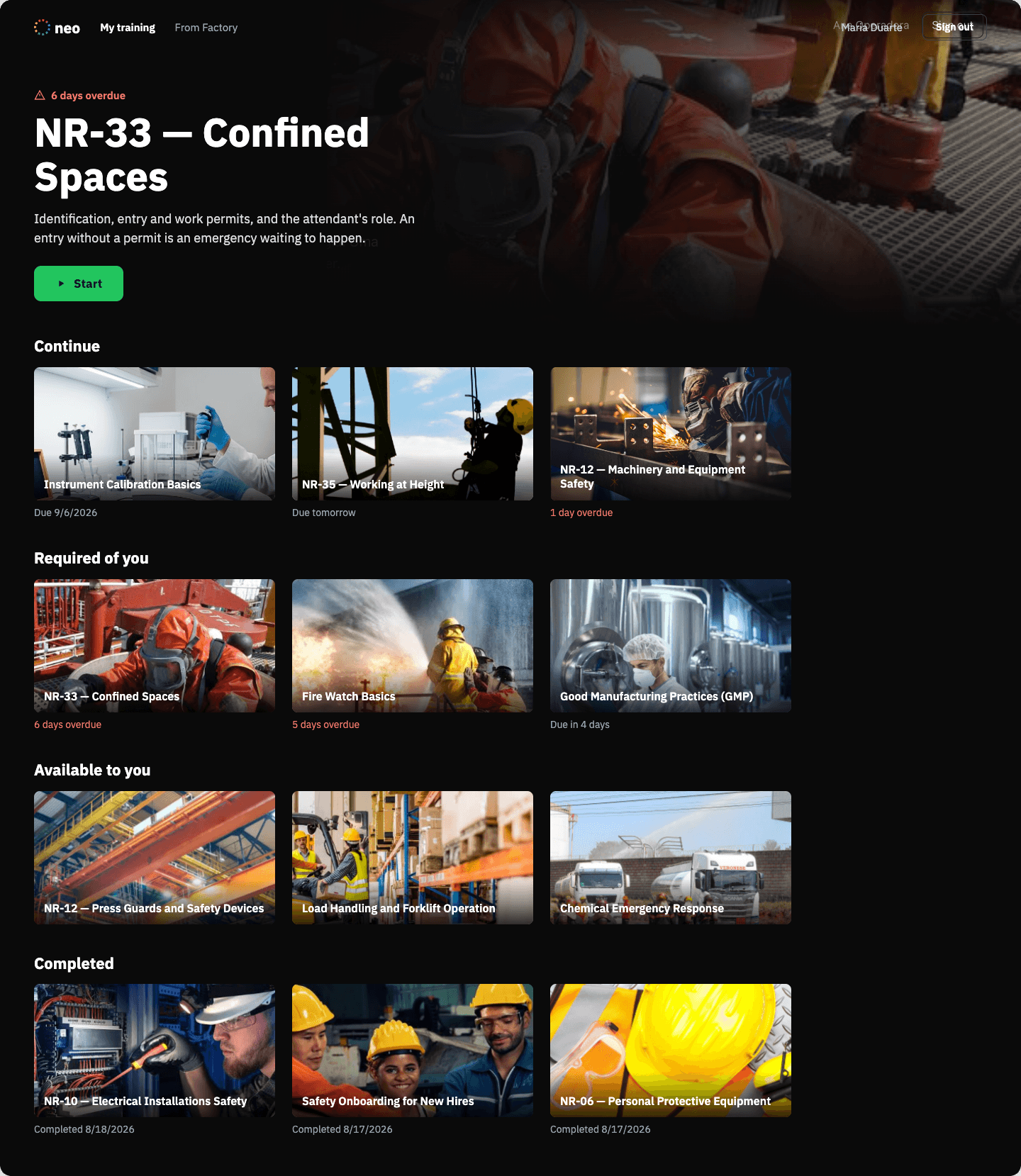
The learner is not handed a console
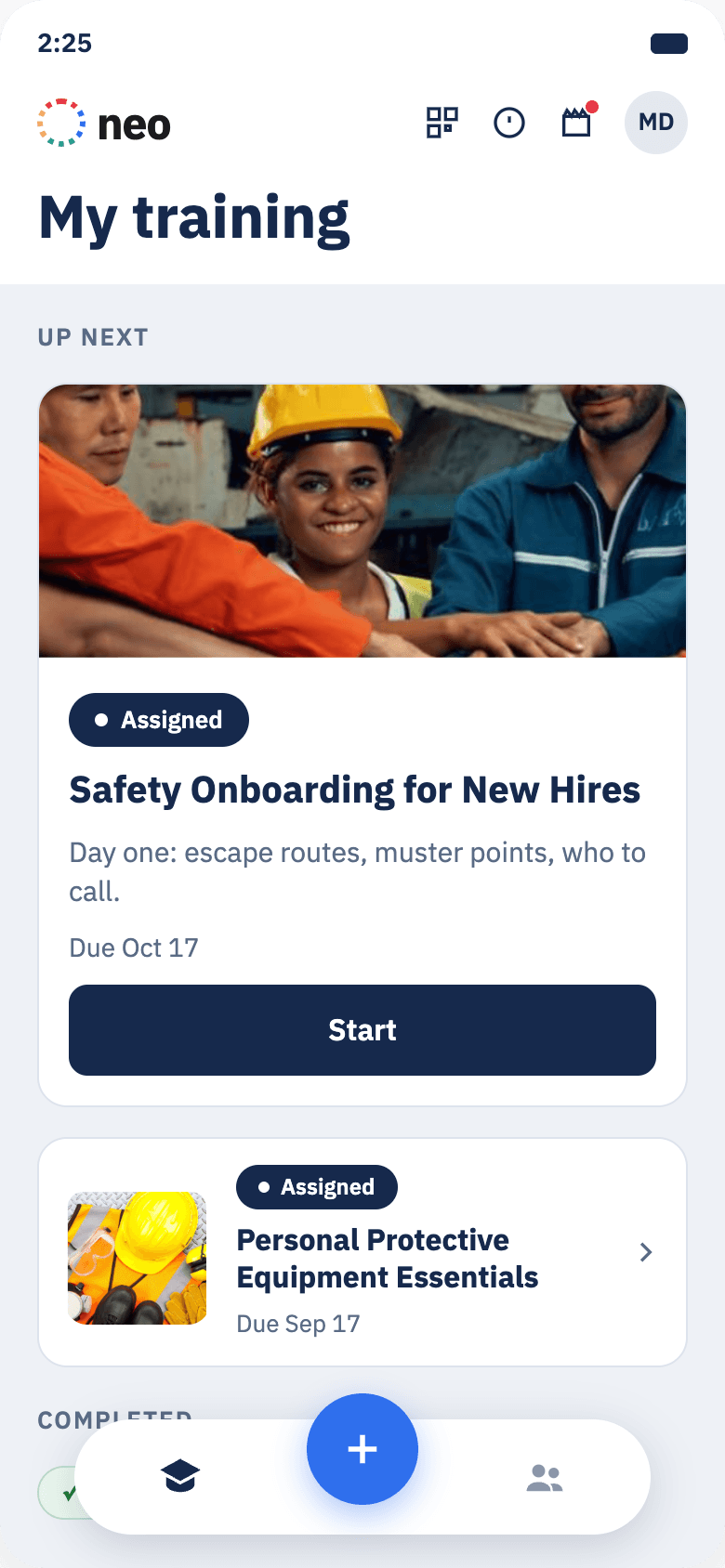
A separate application in its own visual language, because the person taking a training is not the person administering it. The most urgent item sits at the top, then shelves: Continue, Required of you, Available to you, Completed — each with the deadline stated plainly, and overdue in red rather than buried.
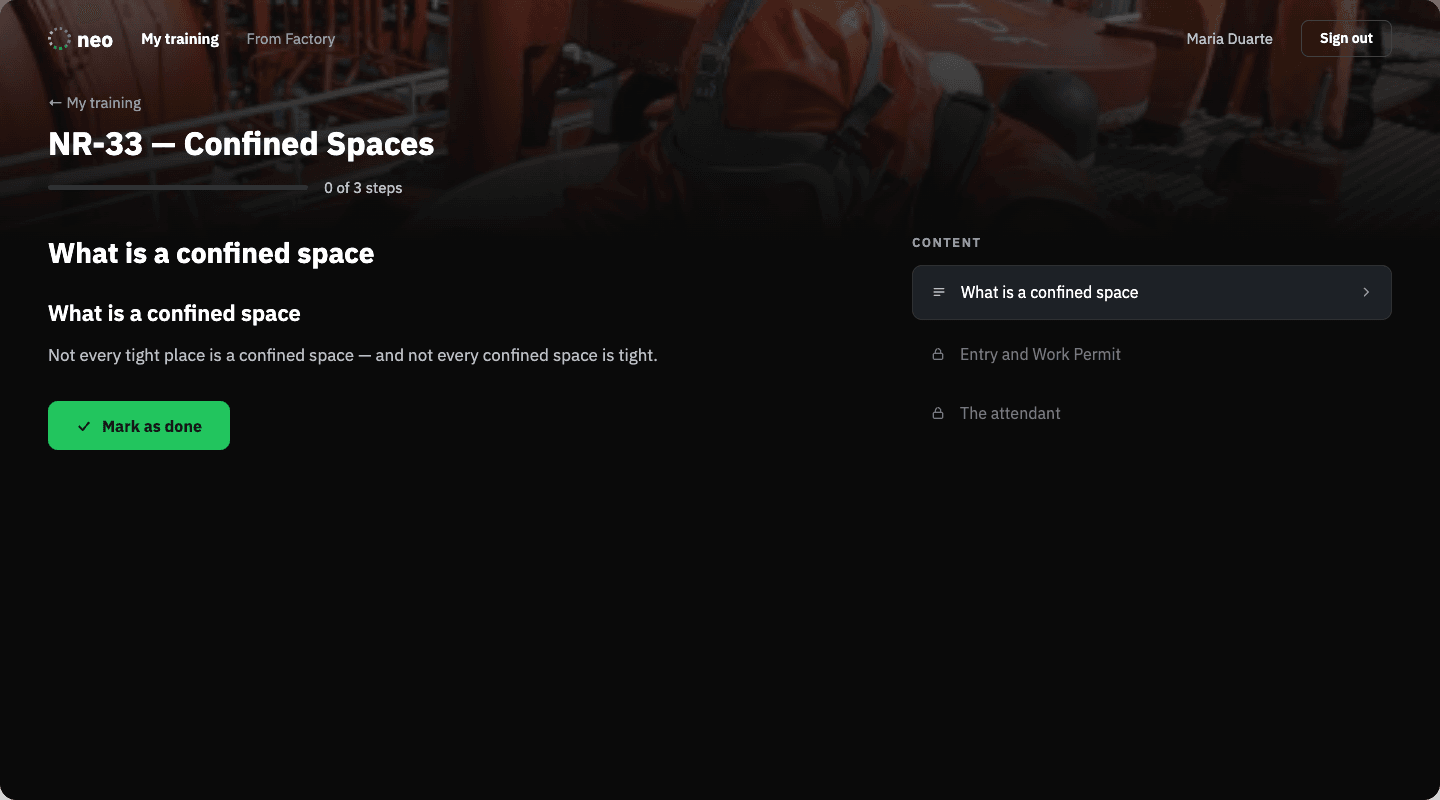
One class at a time
The training resumes where the person stopped. Video plays through the shared player, readings are rendered and documents are shown; finishing every class closes the completion, and the certificate that follows names the version taken, its content hash, the completion date and how long it stays valid.
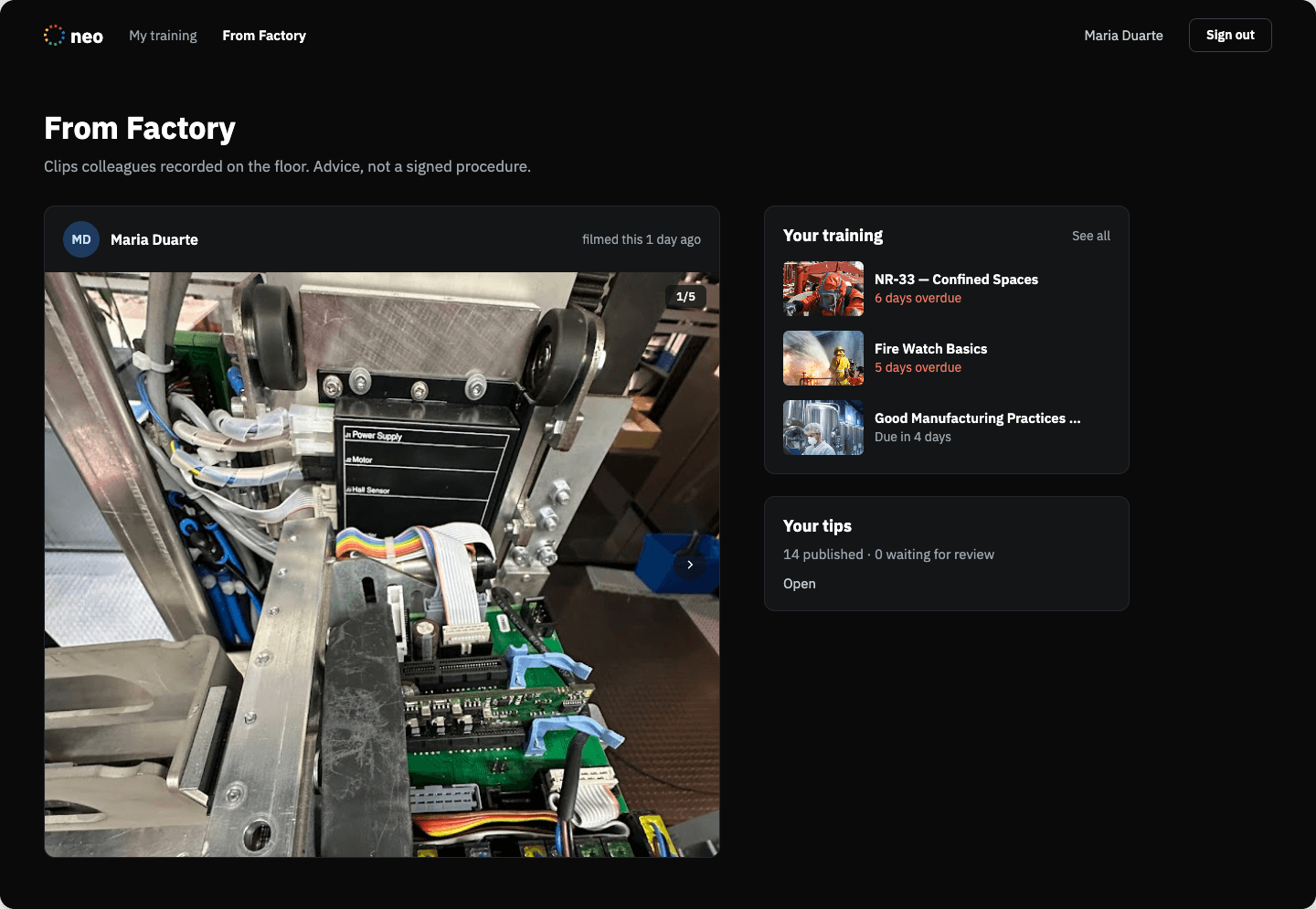
From Factory — the part that is not a course
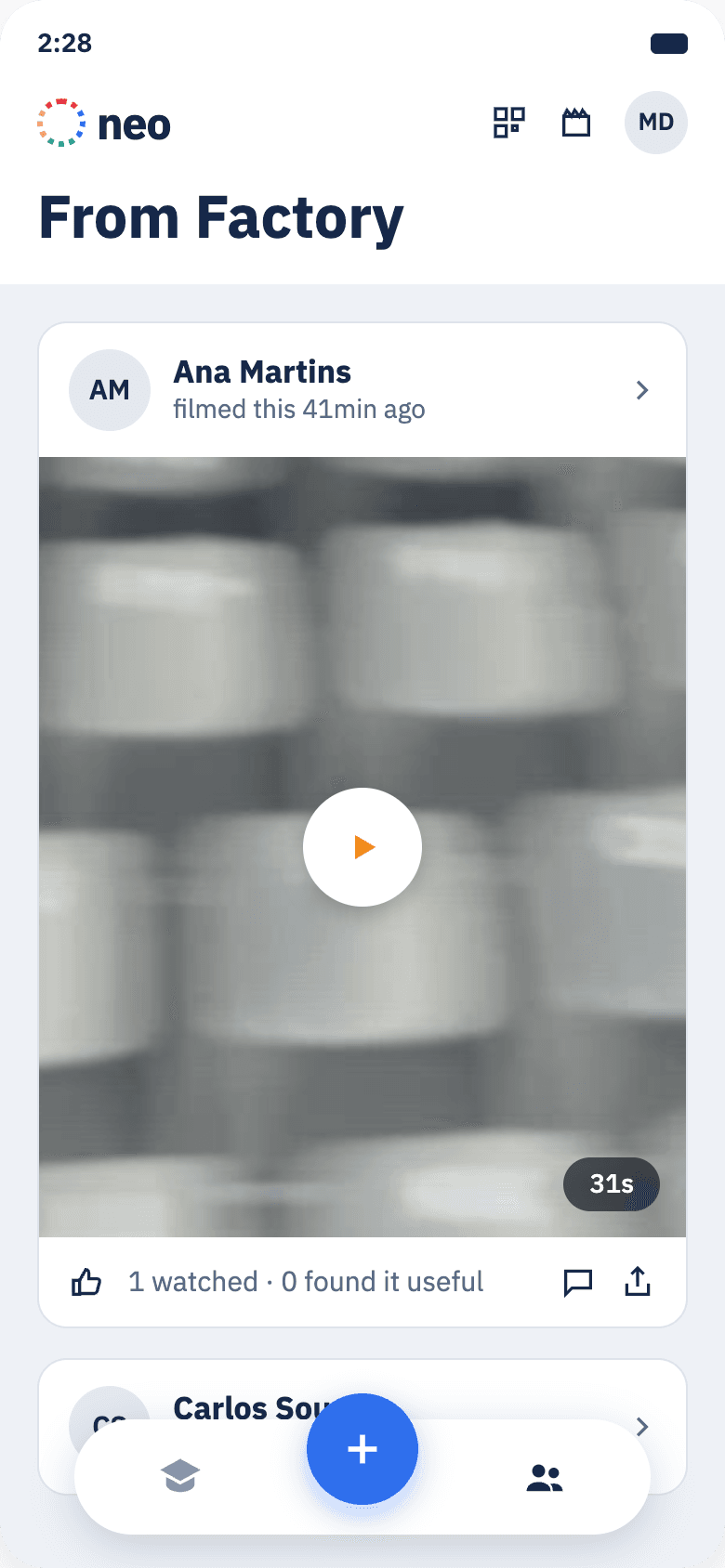
The knowledge that matters most on a shop floor is rarely in the training catalogue. It is the operator who knows why that press jams. From Factory is where that gets recorded and shared — a social surface, not a course.
A tip is a short clip, filmed on the phone, or a carousel of photo steps. It is reviewed before it reaches the floor: advice that carries the plant’s name has to be somebody’s decision. Comments are not reviewed — a colleague answering a colleague appears at once, drawn plainly and never with the weight of the reviewed clip it hangs under, and it arrives live, so a comment written on the web shows up in the app without a refresh.
Training sits beside the feed, never inside it
Merged into one column, an assignment with a deadline takes the same shape as a colleague’s opinion, and each starts to read as the other. So the feed keeps its column and what you owe keeps its own, beside it.
The same training, in a glove
iOS and Android, with the same tree and the same completion rules as the web. Consumption tolerates a dead network and syncs when it returns, and a session is joined by scanning its QR code from the same top bar.
Filmed where the knowledge is
A tip is a short clip filmed on the phone, or a carousel of photo steps for a procedure better shown still. The countdown changes colour rather than explaining itself, the screen is kept awake while recording, and the clip goes into an outbox that survives a crash mid-upload.
Compliance, access and the record
Where it sits in the NEO platform
NEO LMS is the qualification layer of the NEO platform, and it is part of Digital Compliance: the same people whose signatures appear on a batch record are the people whose training has to be current. Where NEO EBR records what was done and NEO W&D records who weighed it, NEO LMS answers whether that person was qualified to.
Assignments that come out of a deviation or a corrective action can be tracked alongside the rest of the work in NEO TASK. And where a MES is present, it can ask NEO LMS whether an operator holds the skills a machine requires before the machine is released.
What each team gets out of it
- An answer, not a reconstructionWho was trained, on which version, when, and until when — exportable, and drawn from a log that is only appended to.
- Signature where it mattersA signing PIN separate from the password, held per person, on the actions that carry regulatory weight.
- Who can run this machine, todayThe qualification matrix as a grid of people against skills, with what is about to lapse surfaced before it does.
- Knowledge that never reached the catalogueFrom Factory: the operator who knows why that press jams, in a 30-second clip, reviewed before it reaches the floor.
- The backlog, honestlyOverdue first, then what is waiting to start, then where the backlog sits by training — instead of a spreadsheet nobody trusts.
- Onboarding as a plan, not a checklistA training plan bound to a role assigns itself to whoever takes that role next.
- Sign-in you already runMicrosoft or Google single sign-on, with local credentials as the fallback and roles scoped to the organization hierarchy.
- One API behind three surfacesConsole, learner site and mobile app share it, and a MES can query qualification through per-organization keys with access logging.
Questions we are asked
If we update a course, what happens to people who already took it?+
Nothing is rewritten. Publishing produces a new version; whoever started the previous one finishes it, and every completion keeps the version it was earned on, along with that version’s content hash. The certificate names it.
Our shop floor has almost no signal. Does it still work?+
Video is delivered adaptively and an offline copy is kept, so a weak connection degrades quality instead of blocking the training. On the phone, consumption is offline-tolerant and sync is deferred until the network returns; a clip filmed on the floor waits in an outbox and uploads when there is signal.
How do people sign in — and what about contractors?+
Microsoft or Google single sign-on, with local credentials as the fallback. One person can belong to more than one organization — an external learner who works for a supplier and also trains with you — and the sign-in asks which, rather than guessing.
Can our MES check qualification before releasing a machine?+
Yes. NEO LMS stands alone, but where a MES is present it can ask whether a given person holds the skills a machine requires. Access runs through per-organization API keys, and every call is logged.
Is From Factory moderated?+
A tip is reviewed before it reaches the floor — advice that carries the plant’s name has to be somebody’s decision. Comments are not reviewed: a colleague answering a colleague appears at once, and arrives live, so a comment written on the web shows up in the app without a refresh. Deleting a comment belongs to whoever wrote it, or to a moderator — deliberately not to the clip’s author, so nobody can silence a correction on their own advice.
Can we open trainings to suppliers without giving them accounts first?+
Yes. An organization can publish trainings to a public page anyone can read without an account — a catalogue, a page per training, and a free sample class so the decision is informed. From there an outsider applies, and an administrator decides.
Bring the trainings you already run and the qualifications you have to prove. We will show how they are authored, assigned and evidenced.