ICH Q10: the PQS is not an org chart
When someone asks for "the plant's PQS," the most common answer is still a neat org chart, an SOP folder, and a slide with ICH Q10's four quadrants. All of that can be necessary. Almost never is it enough.
ICH Q10 (Step 4, 4 Jun 2008; EMA Step 5 effective since 1 Jun 2008 — historically close dates) describes a model of a Pharmaceutical Quality System across the product lifecycle — development, tech transfer, commercial manufacture, discontinuation. What the guideline pushes, in a shop-floor reading, is not another box on the org chart. It is flow that management sustains and that the system of record makes hard to bypass: change, deviation, CAPA, knowledge that returns to the process, improvement that does not die in a workshop.
Org chart ≠ system
An org chart answers who reports to whom. A PQS, in the Q10 sense, answers how product quality is assured when things change — and they always change.
We see the confusion constantly:
- "We have a PQS" = we have a Quality directorate on the chart.
- "We are aligned to Q10" = we trained the guideline once.
- "Knowledge management" = a SharePoint with a thousand folders and a search nobody uses.
None of that is worthless. It is just not the test. The test is usually ruder: when a serious deviation closes, do the cause and corrective action actually change the procedure, the recipe, the EBR limit, the training — or do they only generate one more PDF in the CAPA folder?
What Q10 actually articulates
Without turning the post into a guideline summary, four Q10 ideas weigh on daily work:
- Management responsibility. Not as a slogan. As resource, priority, and accountability when quality and lead time collide.
- A pharmaceutical quality system covering the lifecycle. The same product cannot have "development quality" and "factory quality" that do not speak to each other.
- Two explicit enablers: knowledge management and risk management (Q9). Without them, CAPA and change become ritual.
- Continual improvement tied to process and product performance — not an annual "excellence" initiative.
Q10 is careful to say it does not create expectations beyond regional GMP; what exceeds GMP is presented as optional in the text. In industry practice, the model's value is elsewhere: it gives common language for what inspection already smells when the org chart is beautiful and the flow is broken.
Flows the system enforces
Here is the lens the calendar asked for: PQS as flow the system enforces — system of record, CAPA, continuous change control — not folder drawings.
Paper and email are systems too. They are just systems that forget, duplicate, and forgive the shortcut. Change control in a shared spreadsheet "works" until the third simultaneous version. A CAPA without visible status becomes a promise. A deviation archived with no link to the batch disappears at release.
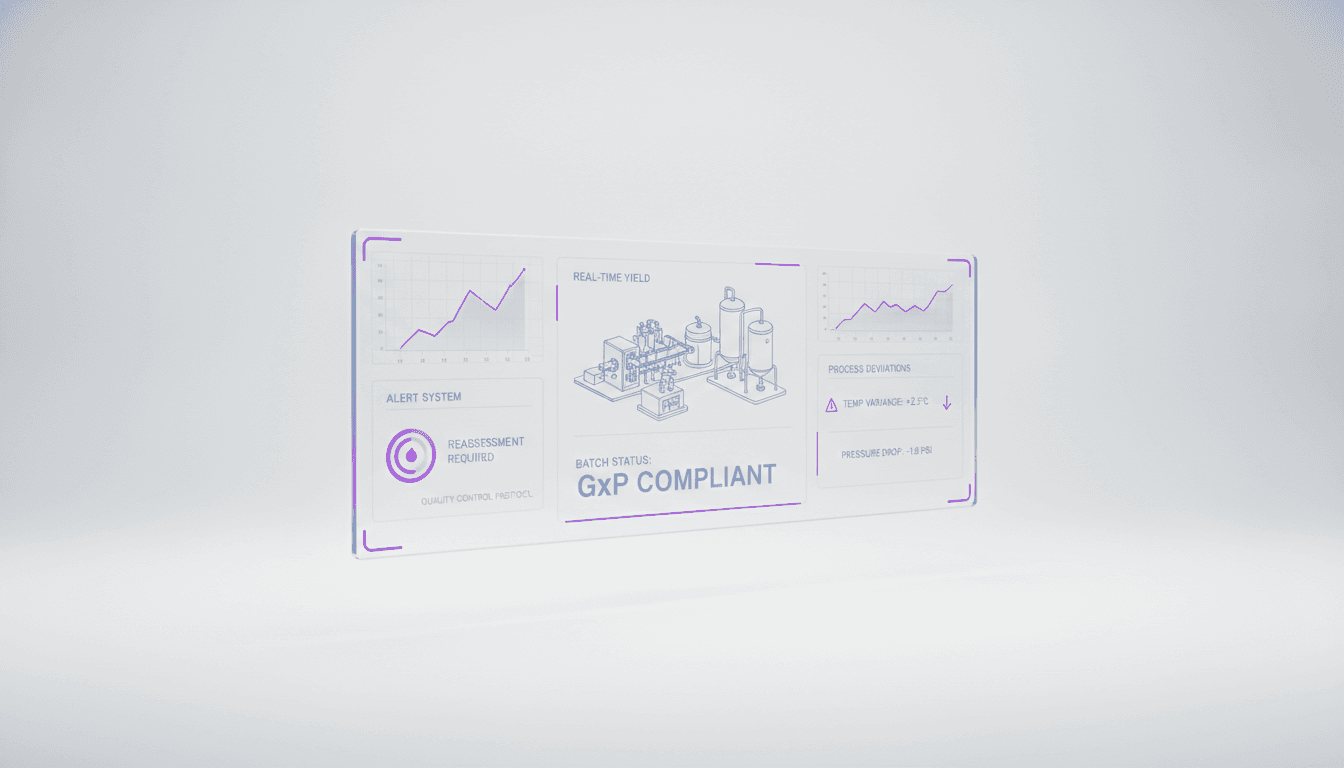
When batch record, change, and CAPA live in the same fabric — with state, owner, due date, and trail — the PQS stops depending only on the right person's memory. Not because software "is the PQS." Because the PQS needs contemporaneous evidence, and contemporaneous evidence without a system of record tends to be reconstruction.
CAPA that changes the system (or does not)
One of the clearest smells of an org-chart PQS is CAPA that ends in "reinforce training" for the third time on the same failure mode. Training matters. When it is the only lever, it usually means the cause in the process or in record design was never touched.
Questions we use in plant conversations:
- Did the corrective action change a limit, sequence, interlock, or master recipe — or only the refresher slide?
- Does the effectiveness indicator look at recurrence of the same deviation, or only "CAPA closed on time"?
- Did the change arising from the CAPA go through the same change-control rigor as any other process change?
Q10 talks about management review and use of data. Without tying CAPA → change → evidence in the record, management review looks green where the floor still bleeds.
Continuous change, not a "change project"
On the org chart, change looks like a department. In the PQS, change is the plant's metabolism. ICH Q10 and, later, the lifecycle conversation with Q12 only make sense if change control is disciplined routine — not a pre-inspection scramble.
That includes "small" configuration changes in electronic systems. Turning a warning into a hard gate, widening a tolerance, reordering a step in the digital recipe: the product impact can match a pen stroke on a paper MBR. Treating configuration as an IT detail punches a hole under the PQS.
Knowledge management without romance
Q10 names knowledge management as an enabler. On the floor, knowledge lives in three places: people, documents, and process data. The first two age; the third, if it exists with provenance, is often what remains when the key analyst leaves.
The link to data integrity is direct and needs no separate post: if critical process data are not retrievable, attributable, and contemporaneous, the PQS's "knowledge management" is broken at the point where continual improvement should feed.
What an MES/EBR does not replace
It is worth being explicit, so this does not become a pitch:
- Software does not create management accountability.
- An EBR alone does not define quality policy.
- A CAPA workflow does not replace competent investigation.
- A green dashboard is not management review.
What the system of record can do — and platforms such as NEO try to do when well implemented — is make the right path the easiest to evidence: batch, deviation, change, and action on the same thread. The PQS remains the organization's. The org chart still exists. Only the test stops being "who reports to whom" and becomes "does the flow hold quality when we squeeze the timeline?"
Signs of a living PQS (and of a slide PQS)
Signs that usually indicate life:
- change and deviation reopen risk (bridge to Q9) with a clear owner;
- CAPA changes the system of record, not only training;
- management review uses recurrence and process, not only document volume;
- tech transfer leaves traces in the same control language as the factory.
Signs of a slide:
- PQS SOP updated; floor indicators flat;
- two systems of truth (paper + electronic) with no death date for the hybrid;
- "knowledge management" = drive; real search = shift WhatsApp;
- inspection prepared with a scramble; next day the same.
Closing
ICH Q10 does not ask us to replace the org chart with software. It asks that the Pharmaceutical Quality System be the set of behaviours and controls that truly govern the product across the lifecycle. An org chart is a people map. A PQS is a map of obligations — and obligations without evidencable flow tend to melt on the second shift.
If in your plant the honest PQS test is still "show the chart and the folder," maybe the next step is not another SOP. It is looking at the last serious CAPA and asking what, in fact, changed in the system of record.
Practical writing on GxP, MES, data integrity and shop-floor systems. A few times a month, no noise.