Open door: the disturbance HVAC feels first
In a GxP production room, temperature and humidity usually own the panel. The door almost never does. This piece zooms in on a trajectory plants underestimate: the door as a process event, not an access detail.
In a solids room (compression), with continuous monitoring of door, differential pressure, temperature and humidity, the correlation was hard to deny. Not shift opinion. Three independent instruments answering the same gesture.
What one observation shows
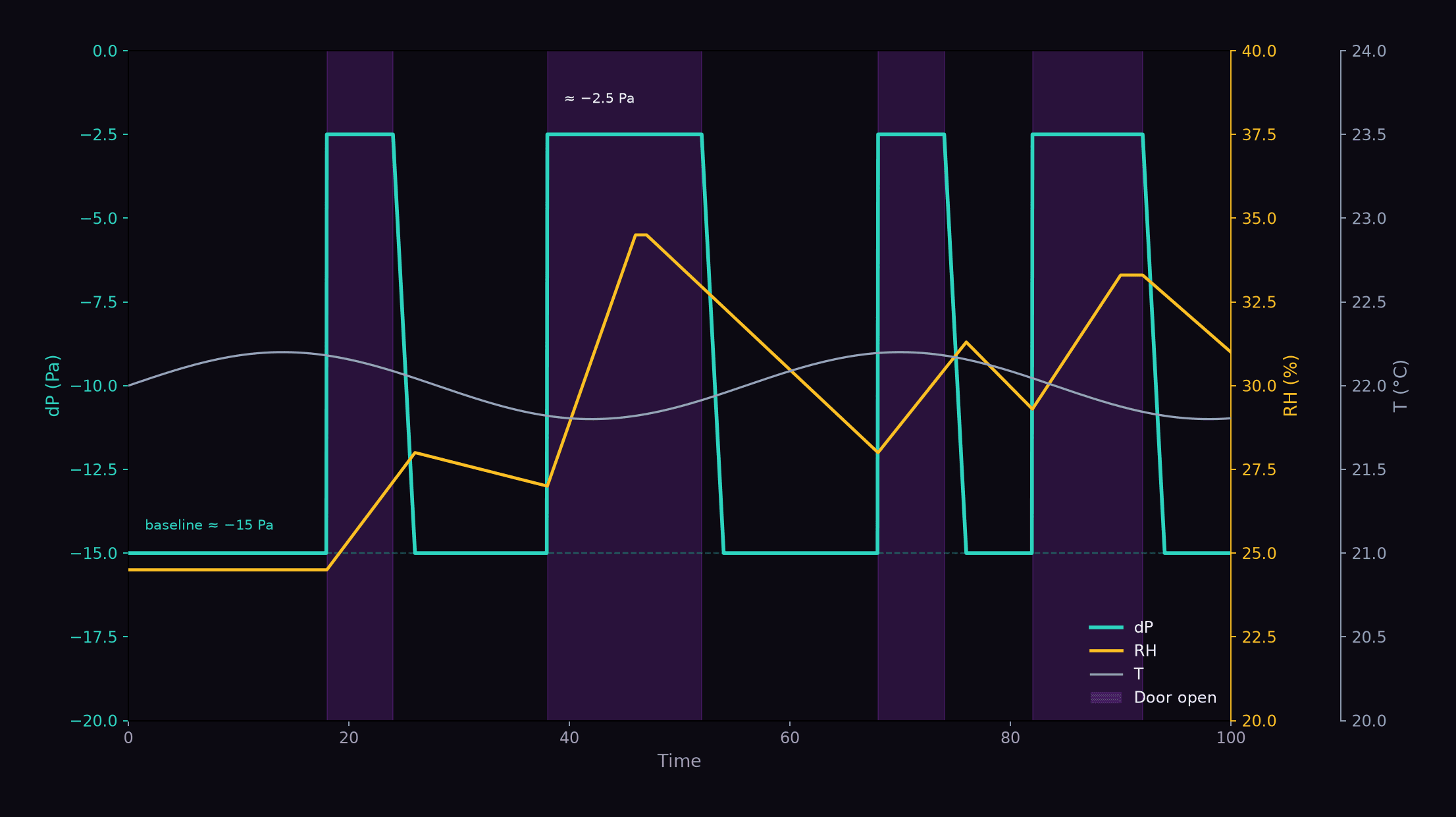
Over a short window of continuous monitoring in a dry room — low humidity baseline, stable pressure cascade with the door closed — the door × ΔP × RH overlay repeated the same pattern:
- With the door closed, differential pressure held in a typical containment band (about −12 to −17 Pa in this observation).
- On each opening, ΔP collapsed immediately toward about −2.5 Pa — on the order of ~85% loss in this observation — and returned to baseline in under two minutes after closing.
- Relative humidity, from a dry baseline (~24–25% RH), rose about +3 to +5 pp per cluster of openings; in the longest episode (~18 minutes open), it reached ~34.5% RH (+10 pp), with recovery over tens of minutes.
- Temperature moved at most ~+0.4 °C: the adjacent space was nearly the same thermal band, so the gradient that mattered was humidity, not temperature.
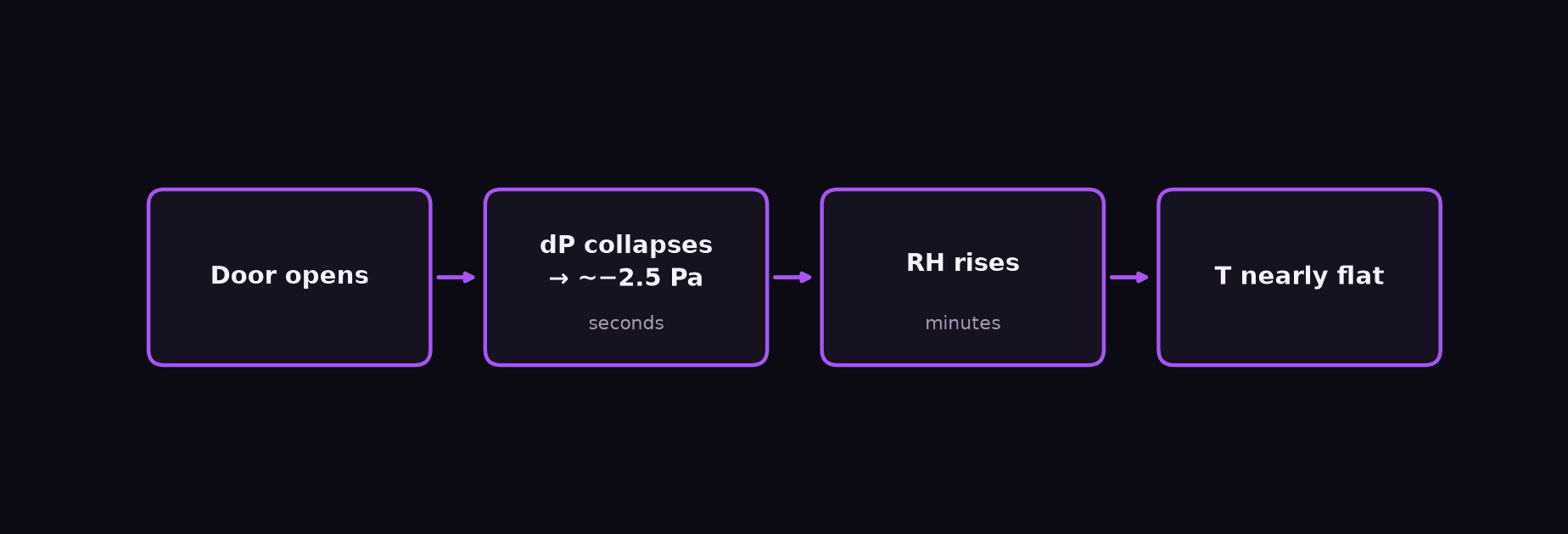
Figures from one observation are not your room’s specification. They train the eye: door → ΔP → RH, on different timescales, on the same wire.
Why the door knocks ΔP down in seconds
A pressure cascade needs a closed path. Open the door and the designed differential between rooms stops being sustained: the ΔP sensor records the collapse almost at the door event.
That is why a near 1:1 match between a magnetic door sensor and pressure drops is so useful in investigation. It does not replace the ΔP alarm — it strengthens the most common operational cause when recovery is fast and the pattern repeats with every passage.
ΔP that falls and returns in minutes, lined up with door events, is rarely an “AHU mystery.” It is usually access.
Why RH rises later — and why T barely moves
In a dry room, the corridor or anteroom is often much wetter. Each opening injects air with more water; indoor RH climbs with a minutes-long lag and takes longer to return, because HVAC must recondition the volume — not only restore the differential.
Temperature in this kind of episode can look “stable” on the chart and mislead the shift: if the adjacent space is in the same thermal band, the T sensor barely moves while humidity has already left the baseline. Reading temperature alone is reading the least sensitive parameter to the door.
Typical guide ≠ qualified specification
“Book” ranges (ISPE / solids guides) help with order of magnitude. They do not replace URS, qualification and the room’s limits.
If the RH specification is tight (for example ≤ 30% for a hygroscopic product), a +10 pp peak after a long door-open may be a recordable excursion — depending on the batch in process. If the band is wider, the same chart still matters: it shows how long the cascade was compromised and how long humidity took to return. In both cases the hedge is the same: what counts in an audit is the area’s qualified specification, not a vendor slide.
The same for negative ΔP in a powder-generating operation: the direction is often correct for containment; drops during opening are physically expected if recovery is fast. The operational risk is the door that stays open — minutes, not seconds.
How to read door, pressure and humidity in one episode
Three practical questions usually separate a “dry alarm” from a useful investigation:
- Was there a door event at the same instant as the ΔP collapse? If yes, the operational root cause already has a strong candidate.
- Did RH start rising minutes later and take longer than ΔP to recover? Typical dry-room pattern with a humidity gradient to the adjacent space.
- Did T stay almost flat? Do not conclude that “nothing happened” — conclude that temperature was not the sensor sensitive to that disturbance.
When three independent instruments line up in time, the conversation stops being shift opinion and becomes a trajectory: who opened, for how long, what cascade and humidity did while the batch was (or was not) in the area.
That is the same shift discussed in environmental monitoring and in online HVAC and energy monitoring: a sensor without episode context is only a larger file; door + ΔP + RH on the same wire becomes control. In area IoT practice, that reading often lives in the NEO SENSOR layer.
What this changes
- In a dry room, the door is often the dominant disturbance: ΔP in seconds, RH in minutes, T almost inert.
- ~85% cascade loss in this observation at ΔP collapse is not a universal magic number — it is an order of magnitude to train correlation, not to copy as a limit.
- Three independent instruments telling the same story cross-check the instrumentation and shorten investigation.
- Prolonged opening (minutes) is the failure mode that most raises RH and nulls the cascade; fast ΔP recovery after closing does not erase the time containment was compromised.
- A typical guide (ISPE etc.) contextualizes; the qualified specification decides whether there was a deviation.
- A door-open (time) alarm plus a sustained out-of-band ΔP alarm, with an owner and a response, usually beats watching one parameter alone at end of shift.
In your plant, did the last ΔP collapse arrive with a door event in the same minute — or only with “odd” RH the next day?
Practical writing on GxP, MES, data integrity and shop-floor systems. A few times a month, no noise.